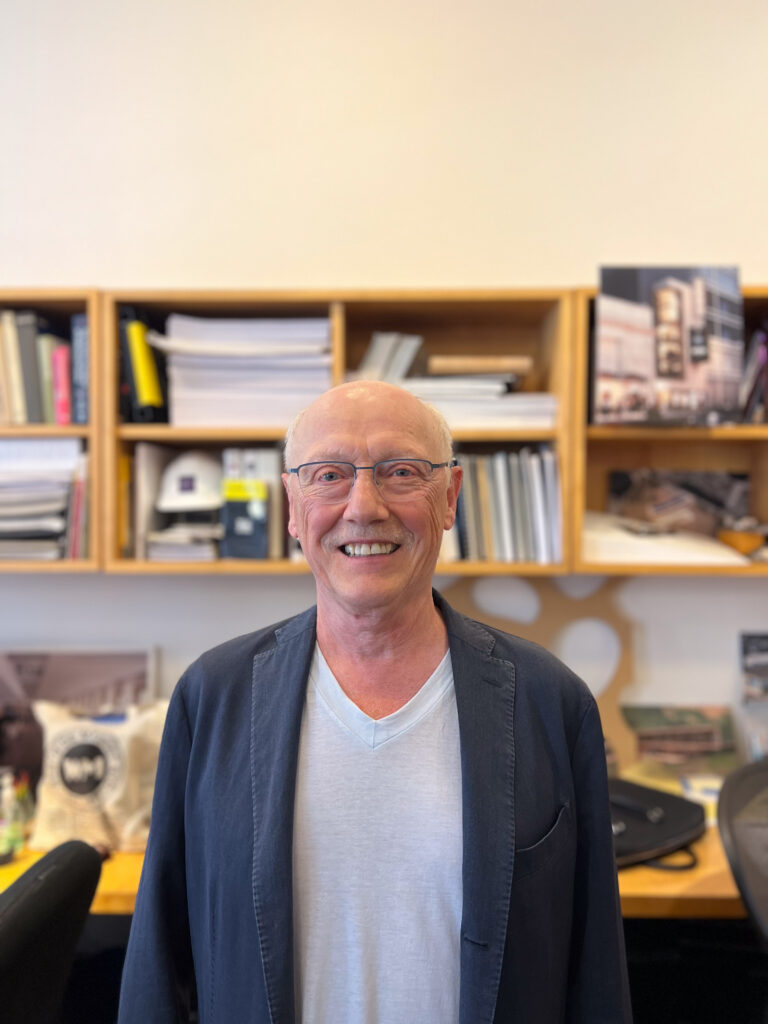
Mitchell Kurtz, AIA, LEED AP is a Principal at Kostow Greenwood Architects. His architectural projects include the New York Theatre Workshop’s Theater, Offices, and Production Shops, Playwrights Horizons, Signature Theater, and work at the Public Theater, Cherry Lane Theater, Daryl Roth Theater, Barnard College, Pratt Institute, Fordham University, The New School, Stamford Center for the Performing Arts, The Frick Collection, St. Ann’s Warehouse, and El Museo del Barrio, among others. He recently spoke with Design 2147 CEO Sisto Martello about designing places of assembly in New York City.
Q: You came to architecture with a background in theater. How did that shape your focus on places of assembly?
A: Well, it probably started when I was ten years old at Camp Wayne for Boys when, during the summer, I participated in the theater activities there. I did that and arts-and-crafts, and I guess I haven’t gone too far from those roots. And then in college, I did theater, and I went to graduate school in theater design and technology and worked in the theater business for about ten years before I decided my destiny was an architect. So I came to architecture with knowledge about theater buildings, theater production, a love of theater people, a love for the event.
And I realized that as an architect, after I finished my internship and I got my license and I somehow started a business, that I actually knew people in the business, and I knew something about show business, and it was a natural market opportunity for me. So there I was, and I knew people, and they had projects. It was a natural outgrowth of my interests and experience.
What was interesting was, as a theater ally, I’m going to do everything I can to help the creative artists, to help them get the show on. And then you realize, wait a second, I have a license as an architect, I also have a public responsibility. And those two things are sometimes in tension.
There are interesting practice techniques that both afford you the opportunity to be the best ally of the producers and the creatives in the theater piece, as well as doing the right thing by protecting the public interest. At the end of the day, anybody who came into a theater or a production environment that you’re responsible for, you want them going home to see their family at night. That’s a very serious responsibility.
Q: You work with a lot of multi-form spaces where seating arrangements change frequently. How do you manage informing your clients of what’s needed?
A: There’s an educational component to what we do, helping to enable production and facility people to work with the creatives to come up with designs for arrangements that suit the show and keep people safe too. Some clients change over many times a year, so we want them to know the basics about seating fixity, aisles, aisle lighting, handrails, guardrails, riser and tread dimensions and markings so they can plan accordingly.
You find ways within the vocabulary of equipment and experience that each institution or producing entity has, to help them do the right thing. Part of helping them includes a pre-inspection after you get approval of the plans for your place of assembly or temporary place of assembly but before an official DOB or FDNY inspection occurs – you go there yourself as the architect.
We’ll check guards or handrails for placement and load resistance. If it’s flimsy, we’ll ask that it be fixed. We’ll check the emergency power test button on illuminated exit signs and emergency lighting so that everything can be made right before inspection and before audiences come. And then, carefully counseling people so that they have the temporary or permanent PA sign up, and they have the paperwork right, because if the paperwork’s not right, any inspection will go to hell fast. If the paperwork’s right, and you have your theater inspection logbook in good shape with the right contents, it tends to go more smoothly.
As part of the practice of working with PAs [places of assembly], once a client gets their PACO or TPACO [Certificate of Operation for Place of Assembly or Temporary Place of Assembly] I have a template letter for the client that’s customized for their particular setting, and they get a six-page note that, with bullets, says, “Put up the sign,” “Check the emergency lighting, have the fire guard certificates in the logbook.” It’s all part of encouraging good compliance.”
Q: What can we learn from major fire disasters in places of assembly?
A: When you look at the history of the Blue Angel fire or Happy Land or The Station fire in Rhode Island or the recent one in Switzerland at La Constellation, there are patterns of problems that are observed: wiring, flammable finishes, obscure exits, and obstructed exits.
I went to a client’s place once, and it was not long after the Rhode Island fire, and they had this egg crate foamin an exit passageway. I said to the facilities guy, “You can’t have this kind of foam here.” And he says, “Oh, no, it’s fine.” I said, “Well, it could be flammable.” He says, “Well, let’s check it.” He rips off a piece and he takes out a lighter. I say, “Wait, wait, wait. Not here. Let’s go outside and do this.” So we go outside, and we lit the match to it, and it goes “whoosh.” So the foam got removed real fast.
The other thing: there are issues with design elements that can be seen in several disasters, like in the Station fire in Rhode Island, a place had four exits, three of which you couldn’t really see from the main occupied space. What we know from human behavior is that people tend to leave the way they came in. This is recognized in the latest building codes, which require newly built assembly spaces to have their main exit sized for at least half the occupant load.
If there’s only one way that people come in, then there’s a design responsibility to make sure that all the other exits are visible or made visible. In the old days, you used to go into a theater – matter of fact, the NYC fire code and rules still say there should be an announcement informing the audience of the locations of exits, like in airplanes, there’s exits there, and there’s exits there, and there’s exits behind you. The Fire Code allows the Commissioner to grant an exception if exits are clearly visible from every audience position. So since the Building Code requires exit signs to be visible from any direction, it’s become the common practice not to make the announcement. There’s a responsibility to make sure that if the exit path is not prominent, you place directional signs to make the paths prominent as you can – no curtains and, there’s no other obstructions.
Q: How does the 2022 code address the issue of exit distribution?
A: That’s the reason why the 2022 code and the subsequent and the forthcoming existing building code, the EBC, have this notion of a main exit, where the main exit has to be able to serve at least 50% of the occupant load, and then the remainder of the exits have to serve at least 50% of the occupant load.
Before that, let’s say you needed four doors. Your main could be one, and your emergency doors, the outside ones that you don’t use, could be three. That’s not the way it works anymore. Even if the main exit is 100% of the capacity, the other ones — the non-main exit openings– still have to serve at least 50% of the occupant load. It’s written into the code that you need this kind of distribution. And there are further distribution requirements where specified portions of the exit openings need to be to places normally used as an entrance, and the portion varies depending on how much above or below grade the assembly space is located.
That’s the class one, class two, class three distributions specified in the NYC Building Code. It’s in addition to those main exit distributions. The IBC-based codes don’t have any of that classification of exit openings and exit access doors.
Q: You were on the Use, Occupancy, and Egress committee for the new Existing Building Code. Can you tell us about that experience and what the EBC means for places of assembly?
A: It was a good experience, lots of well-informed and well-intentioned people pitching in. Knowing a little something about the theater, I was able to add a couple of ideas that were embraced by the committee. Fire Department’s there. Buildings Department’s there. The Port Authority is there. It’s a big group with a lot of divergent interests, and so to find common interest is hard. And it’s all developed by consensus. If any one person objects, it’s going to go through an appeal process which everybody wanted to avoid. So, there’s a real incentive to form a consensus and to dull the sharp edges.
The EBC is going to be an architect’s friend. It is better than having to constantly go for thousand-dollar CCD-1s all the time. The basic concepts are: an existing building, if it’s lawfully occupied, either through CV\ofO or approved plans, the existing egress is okay. And then when you do something new, if you’re not increasing the occupant loads, then you can change the occupancy group classification, you can change how a space is used, and you can make use of the existing egress, without having to redo the entire egress scheme provided it meets the current capacity standards – and that’s very advantageous.
Q: Can you get more specific about the places of assembly section of the EBC?
A: The places of assembly piece – which is in, for those people with a pencil and pad, EBC 305.5.18 – is very easy to read and readily understandable. If you’re doing a production in a place of assembly, rearranging the seating and the stage – let’s say you have a one-story building and you’re rearranging all of it – well, using the work area criteria in the EBC, that would be 100% of the work area being affected, so it’s suddenly a Level Two, which has more advanced requirements. The EBC defines all changes of platforms, stage, and seating, provided no other alterations are being done as Level One. That’s a great, great boon. Level One means the work you do has to conform to the EBC, which is essentially the 2022 code, but nothing else, which is great. You don’t have to go back and dig around the egress or dig around other facilities in the building. You don’t have to change the plumbing or any of that stuff provided there’s no increase in occupant load.
So that’s really good. And then for special occupancy structures established under the 1938 Building Code or prior codes, pretty much the same thing applies. You still don’t need a place of assembly permit in a special occupancy structure, so while the 1982 Fruchtman memo is going to be obsolete, the same content of it is now in the EBC.
The EBC allows work to be done in the space. That work needs to comply with the current code, but other parts of the building can be used and measured against 2022 code criteria. If you have old exit doors, you can still use the 0.2 inches per person standard on it. Same thing with aisles. Steps get evaluated at 0.3 inches per person even if the minimum stair width or riser/tread relationships don’t conform to the current standards.
Q: What does the EBC require when setting up a new place of assembly in an existing building?
A: It asks you to do five things to bring things up to current standards. The first: the finishes should comply with current standards; second, guards and handrails; third, the means of egress and means of egress exit signs and lighting should work; and fourth, what you’re doing should be accessible.
There’s a new thing in there, too, the fifth requirement, which is that an architect is required to basically investigate the entire means of egress route from the place of assembly out to the street. If there’s something happening there that needs correction, you’re responsible to correct it or get the landlord to correct it. But you’ve got to make note of it, and it has to then be corrected.
I think that’s smart, because any responsible architect would not have just stopped at the exit opening doors. You would walk the whole path and see that the path to the street is free and clear.
Q: What excites you most about the 2022 EBC code for places of assembly? What’s the biggest highlight?
A: I think the ability to use an existing space without having to fight its character or its constraints, and that the existing conditions accepted if it’s a legally occupied condition (subject to the five compliance things just mentioned), is really greatly advantageous.
I always think of codes as having a tool to work with, like a carpenter has its tools. Open up your toolbox and what do you have? You have design knowledge, you have knowledge about people, you have knowledge about materials, and you have the code there. You use all these tools you to create something. So rather than understand the code as an impediment, embrace it and see it as a creative tool because, applied in a creative and professional responsible manner, it can help get you what you want.
The fact that the EBC embraces many of the 2022 code provisions is really quite nice. Handrails and guardrails can be adjusted to a lower height for sightline purposes; that didn’t exist before 2022, and that’s built in. The idea that a guardrail on the end of a seating bank can be the handrail, so you don’t need two, like in a stair where you need a guardrail and a handrail, is a good provision. The elimination of the prohibition that a cross aisle can’t be within twelve feet of the stage – that was always a real problem, thankfully that’s been eliminated.
There are a lot of things in the EBC that make it easier to practice and allow the architect to support the artists in the theater, that I think are very helpful.